
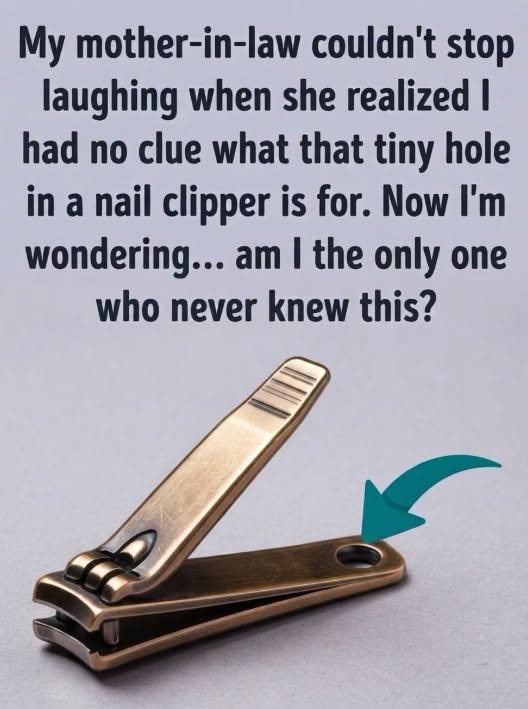
Have you ever looked closely at a pair of nail clippers and noticed that tiny round hole near the end of the handle?
You probably have.
Maybe you’ve even wondered about it for a second before deciding it was simply part of the design.
After all, nail clippers are pretty straightforward.
You squeeze them.
They cut your nails.
You put them back in the bathroom drawer.
End of story, right?
Well… not quite!
That little hole has a purpose, and once you know what it’s there for, you’ll probably look at your nail clippers differently.
It’s one of those tiny design details that most of us completely overlook because we’ve been using the object for years without ever stopping to ask how every part of it works.
And here’s the fun part:
That little hole isn’t necessarily just a hole.
On many traditional nail clippers, it is part of the way the tool is constructed and can also serve a practical purpose related to the lever mechanism.
Let’s take a closer look.
First, Let’s Look at How Nail Clippers Actually Work
Before explaining the mysterious hole, it helps to understand what’s happening when you squeeze a pair of nail clippers.
A traditional nail clipper has several basic parts:
- Two cutting edges
- A pivot or hinge area
- A lever
- A pin or post
- The familiar folding handle
When you press down on the lever, it transfers force to the cutting jaws.
That mechanical advantage allows the small tool to generate enough force to cut through a fingernail or toenail without requiring much effort from your hand.
It’s a beautifully simple example of mechanical engineering hiding in an everyday bathroom object.
And that tiny hole?
It’s connected to that design.
So What Is the Small Hole For?
On many nail clippers, the hole in the end of the lever is associated with the folding lever and its retaining mechanism.
The lever needs to be attached to the clipper body in a way that allows it to move while remaining securely connected.
The small opening can be part of the construction that accommodates the retaining pin or helps form the attachment point.
That’s why you may notice the hole in the movable handle rather than somewhere completely unrelated to the mechanism.
In other words, what looks like a random decorative detail can actually be part of the engineering that makes the clipper work.
Tiny hole. Surprisingly important job.
But There’s Another Clever Detail Hiding There
Here’s where nail clippers get even more interesting.
The lever isn’t simply a piece of metal that you push down.
It’s designed to provide leverage.
Your finger applies force at one end of the lever, while the mechanism transfers that force toward the cutting jaws.
Because of the lever’s geometry, a relatively small movement from your finger can produce a much stronger squeezing action at the cutting edges.
That’s why nail clippers can cut surprisingly tough nails despite being such a tiny tool.
The designers didn’t need a large machine.
They just needed the right mechanical arrangement.
Why Does the Lever Fold?
You’ve probably noticed that the nail clipper handle can usually rotate or fold.
That isn’t just for fun.
When the clipper isn’t being used, the lever can be folded down against the body of the tool.
This makes the clipper more compact and reduces the chance of the lever catching on things inside a toiletry bag or drawer.
It’s another example of a design feature that seems so normal that we rarely question it.
Is the Hole Used to Hang the Nail Clippers?
This is one possibility people often assume when they see a hole in a small household object.
And sometimes holes really are designed for hanging.
But you shouldn’t automatically assume that’s the purpose of every hole you see on a nail clipper.
The exact design varies between manufacturers and models.
On some tools, an opening can have more than one practical function, while on others it may primarily relate to how the lever is assembled.
That’s why it’s better to look at the complete clipper rather than assuming that every round opening serves the same purpose.
Why Do So Many Nail Clippers Look Almost Identical?
This is another fascinating part of the story.
Nail clippers have been produced in broadly similar forms for generations because the basic mechanical problem hasn’t changed.
You need:
- A pair of sharp cutting edges.
- A way to bring those edges together.
- A lever that gives you mechanical advantage.
- A compact design that fits comfortably in your hand.
Once manufacturers found a design that worked well, there wasn’t much reason to reinvent the entire tool.
That’s why the nail clipper sitting in your bathroom today can look remarkably similar to ones used decades ago.
