
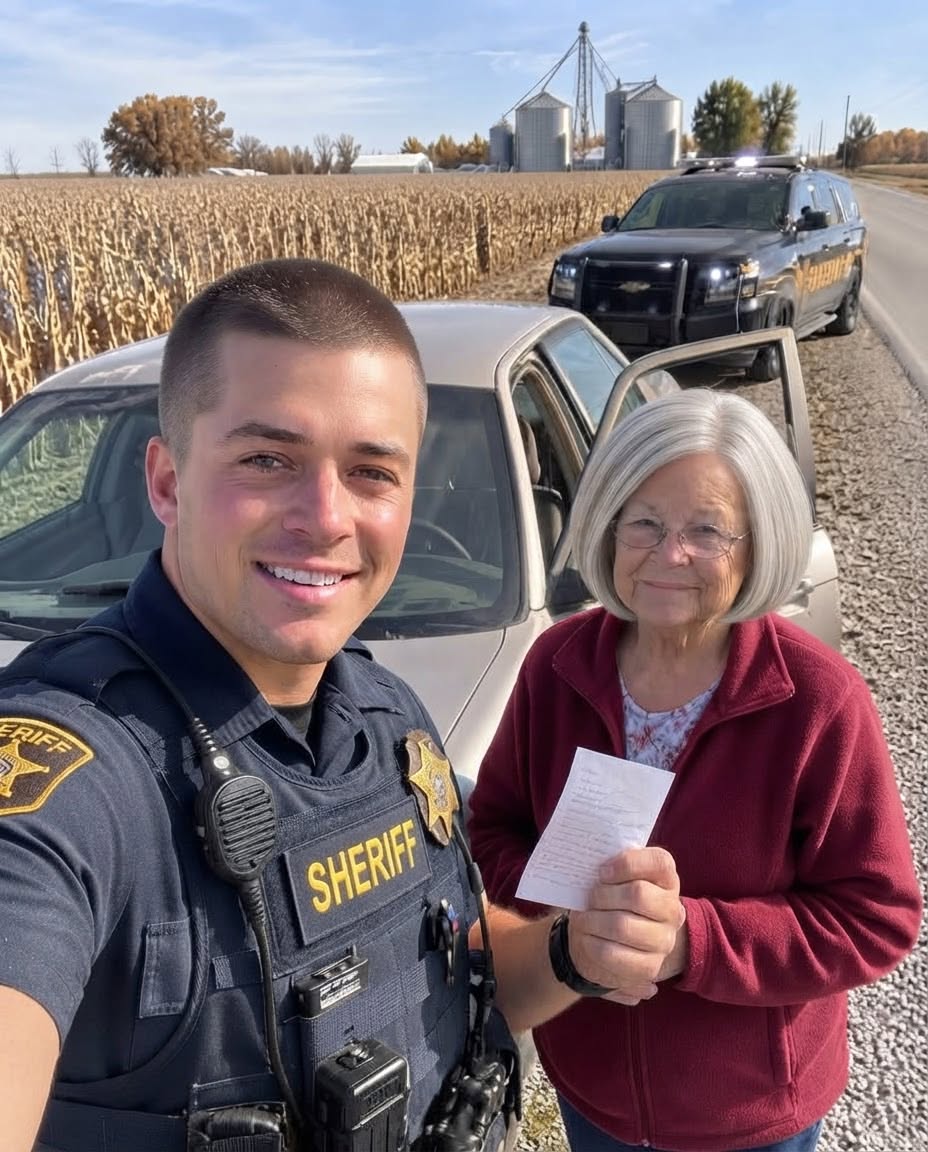
Finally, Walt said, “I don’t know what I would have done without her voice that night.”
Kyle slowly looked at my mother.
The woman he’d questioned about her memory.
The woman he’d left standing in the heat.
The woman whose paperwork he’d dismissed without understanding her circumstances.
She was the same person who’d helped keep his father calm until rescuers arrived.
A few minutes later, Sheriff Hanley pulled up.
He stepped out of his vehicle and approached Mom immediately.
“Shirley, are you all right?”
She gave him a familiar smile.
“I’m fine, Tom. Just a little warm.”
He gently guided her toward an air-conditioned vehicle and made sure she had water.
Then he turned to Kyle.
The young deputy stood silently beside his patrol car.
The sheriff asked him to explain what had happened.
Kyle struggled through the account.
When he finished, Hanley removed his badge as part of an immediate temporary reassignment.
“You’re going to spend the next month working overnight dispatch,” the sheriff told him.
Kyle looked startled.
“Sir?”
“You need to understand what people experience when they call us for help.”
The sheriff continued.
“You’ll listen to emergency calls. You’ll work beside experienced dispatchers. And you’ll learn why patience and respect matter just as much as knowing the rules.”
Then he looked toward Mom.
“Shirley, if you want to make a formal complaint, we’ll make sure it’s handled.”
My mother shook her head.
“I don’t want that young man’s career ruined, Tom.”
Kyle looked up.
“But I do want him to learn something.”
She turned toward him.
“Every person you stop has a story you don’t know. Some are frightened. Some are ill. Some are simply confused about paperwork.”
Her voice remained gentle.
“They deserve to be treated with dignity while you figure things out.”
Kyle lowered his head.
“I’m sorry, Mrs. Hagen.”
Mom nodded.
“Then make sure the next person has a better experience.”
That evening, I visited the dispatch center carrying my mother’s old headset.
I’d found it carefully stored among her belongings years earlier.
It was worn from use, but she’d never been willing to throw it away.
Kyle was beginning his assigned overnight shifts.
He sat beside an experienced dispatcher who had once trained under my mother.
I watched as a call came through.
Someone on the other end sounded frightened.
Their words were rushed and difficult to understand.
The dispatcher leaned toward the microphone.
“It’s all right. I’m here. Tell me what’s happening.”
She spoke slowly.
Calmly.
Without judgment.
For the first time, I truly understood what my mother had done night after night for more than three decades.
She hadn’t simply answered telephone calls.
She’d helped people find their way through emergencies when they were too frightened to think clearly.
And she’d done it while the rest of us slept comfortably at home.
As a child, I’d sometimes resented her job.
She’d missed school activities.
Family dinners.
Even some of my Friday night football games.
I remembered looking toward the bleachers and wishing I could see her sitting beside Dad.
For years, I’d believed work had simply kept her away.
But later, Mom told me something I’d never known.
She’d listened to broadcasts of every one of those games whenever she could.
While sitting in the dispatch room, she’d kept a small radio nearby.
Between emergency calls, she’d followed the scores.
She remembered the exciting plays.
The close finishes.
And the nights when our team barely managed to win.
She’d been cheering for me from miles away.
Even when I couldn’t see her.
That revelation affected me more than I expected.
All those years, I’d thought of Mom as someone who occasionally missed important moments.
I’d never considered how hard she’d worked to remain part of them.
A few weeks after the incident on County Road 6, Kyle visited our house.
He stood on the porch holding his hat.
Mom invited him inside.
He looked nervous.
“Mrs. Hagen, I wanted to thank you.”
She raised an eyebrow.
“For what?”
“For not giving up on me.”
