
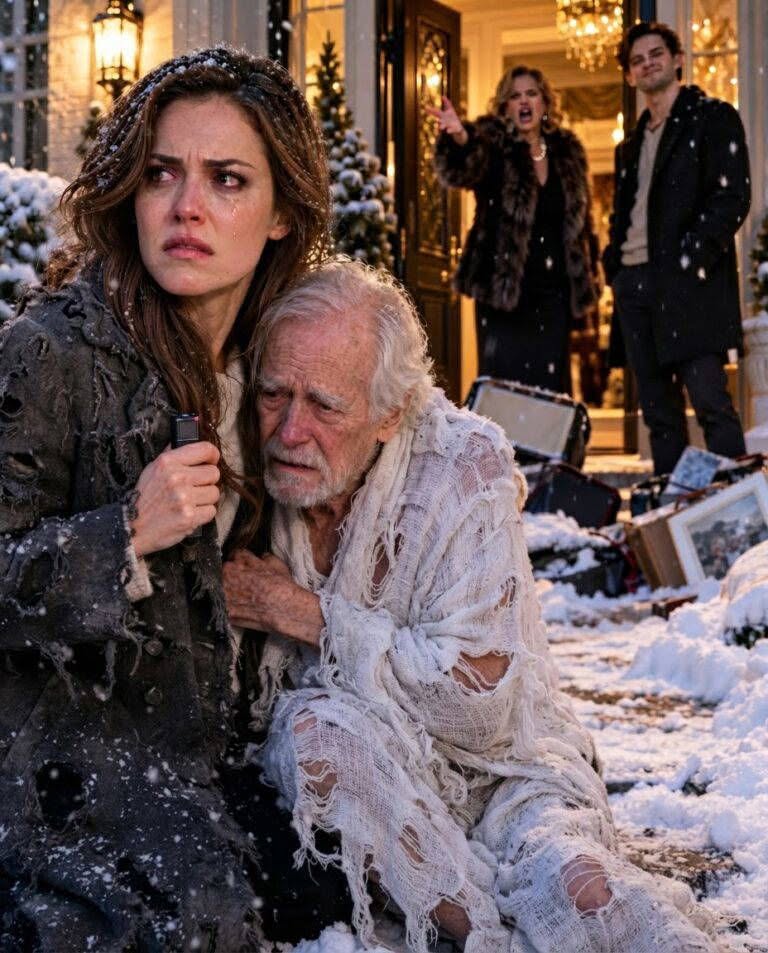
And the people who were supposed to care for him were sending him into a freezing winter storm.
What Gloria didn’t know was that I’d been documenting everything.
And within seven days, the woman who believed she controlled my father’s entire fortune would learn exactly how wrong she was.
“Darren, that’s enough!” I cried, hurrying forward to support Dad before he lost his footing on the icy steps.
His body trembled against mine.
He was eighty years old, still recovering from a mild stroke, and had been discharged from the hospital only forty-eight hours earlier.
His doctor had been very specific about what he needed.
A warm environment.
Regular medication.
Plenty of rest.
And as little emotional stress as possible.
Instead, he was standing outside his own home wearing slippers and a thin robe while snow gathered around his feet.
Gloria stood in the doorway, wrapped in an expensive silk robe my father had given her the previous Christmas.
Her expression was filled with irritation.
“When I married him, I expected a husband,” she declared. “Not someone who needs constant attention.”
I stared at her.
Behind Gloria was the beautiful house my father had spent four decades working to afford.
It was the home where I’d grown up.
The place where my mother used to display our family photographs on the mantel.
But after Gloria married Dad, those pictures gradually disappeared.
The familiar scent of cedarwood and fresh coffee was replaced by Gloria’s expensive perfume.
And somehow, the home my father had built became a place where he was treated like an unwanted guest.
Darren appeared behind his mother and tossed my travel bag onto the snowy porch.
“You heard her, Claire,” he said dismissively. “Take your father somewhere else. Find a motel, a care facility, whatever you want. Just don’t bring him back here.”
Dad tried to respond, but a cough interrupted him.
I wrapped my scarf around his neck and carefully helped him toward the driveway.
Then Gloria said something that made me stop.
“And don’t bother returning tomorrow. Your father’s finances will be properly managed from now on. He’s already signed the necessary documents.”
I turned slowly.
“What documents?”
For the briefest moment, uncertainty crossed her face.
Darren gave a smug laugh.
“That’s none of your concern. You’re just the daughter who suddenly remembered she had a wealthy father.”
I looked at him without answering.
He had no idea why I’d returned.
Three weeks earlier, Dad had called me late one evening.
His voice had been barely above a whisper.
“Claire, I can’t find my medicine,” he’d told me. “Gloria keeps bringing me papers to sign. I don’t understand what she wants.”
He sounded frightened.
When I asked whether everything was all right, he hesitated.
Then he said something I’d never forgotten.
“I don’t think I can trust anyone here.”
That was why I’d come home.
Not for an inheritance.
Not for the house.
Not for a single dollar.
I came because my father needed help.
And Gloria and Darren had made a serious mistake about who I was.
They remembered the young woman who’d worked as a waitress while finishing college.
They still thought of me as the uncertain twenty-two-year-old who’d once struggled to pay rent.
They didn’t know that I was now a forensic accountant.
My firm specialized in investigating suspicious financial transactions, including cases involving the exploitation of older adults.
I’d spent years helping attorneys and investigators trace concealed payments, questionable transfers, and falsified financial records.
And there was something else Gloria didn’t know.
Inside my coat pocket was a small recording device.
It had captured our conversation.
Every remark.
Every admission.
Every word about those mysterious documents.
I helped Dad into my car and turned the heater up.
Then I gently wrapped a blanket around his shoulders.
From the front doorway, Gloria gave us a dismissive little wave.
I looked back at the brightly illuminated house.
And I made myself a promise.
**Give me one week.**
**PART 2: THE EVIDENCE THEY NEVER EXPECTED**
I didn’t take Dad to a shelter or a cheap roadside motel.
Instead, I brought him to a private rehabilitation clinic covered under an emergency medical benefit provided through my employer.
The nurses immediately settled him into a warm room.
A doctor reviewed his medication and adjusted his recovery plan.
By the following morning, Dad looked noticeably better.
Some color had returned to his cheeks.
When I sat beside his bed, he reached for my hand.
“Claire,” he whispered, “they told me you didn’t want anything to do with me anymore.”
My chest tightened.
“I know, Dad.”
“They said you’d abandoned me. That you were too busy with your own life.”
I gently squeezed his fingers.
“I never stopped caring about you.”
His eyes filled with tears.
“Gloria told me I’d lose the house if I refused to sign. She said I was too confused to understand anything anymore.”
I leaned closer.
“Dad, you were recovering from a serious medical event. You needed help understanding those documents, not pressure to sign them.”
He looked down.
“I should’ve listened when you warned me.”
“We can’t change what’s already happened,” I told him. “But we can make sure it doesn’t continue.”
That afternoon, I opened my laptop and began examining the financial records Dad had authorized me to review.
The first discoveries were troubling.
Unusual withdrawals from his accounts.
Changes to beneficiary information.
New credit cards issued in his name.
Documents suggesting that someone had attempted to establish power of attorney shortly after his stroke.
Then I found records of something even more suspicious.
The security system inside Dad’s house had been disconnected around the same time Gloria arranged for a safe to be removed from his office.
But she had overlooked an important detail.
Years earlier, after someone attempted to break into Dad’s property, I’d helped him install a security system that automatically saved recordings to cloud storage.
Gloria apparently believed that unplugging the hallway camera would erase its earlier footage.
It didn’t.
