
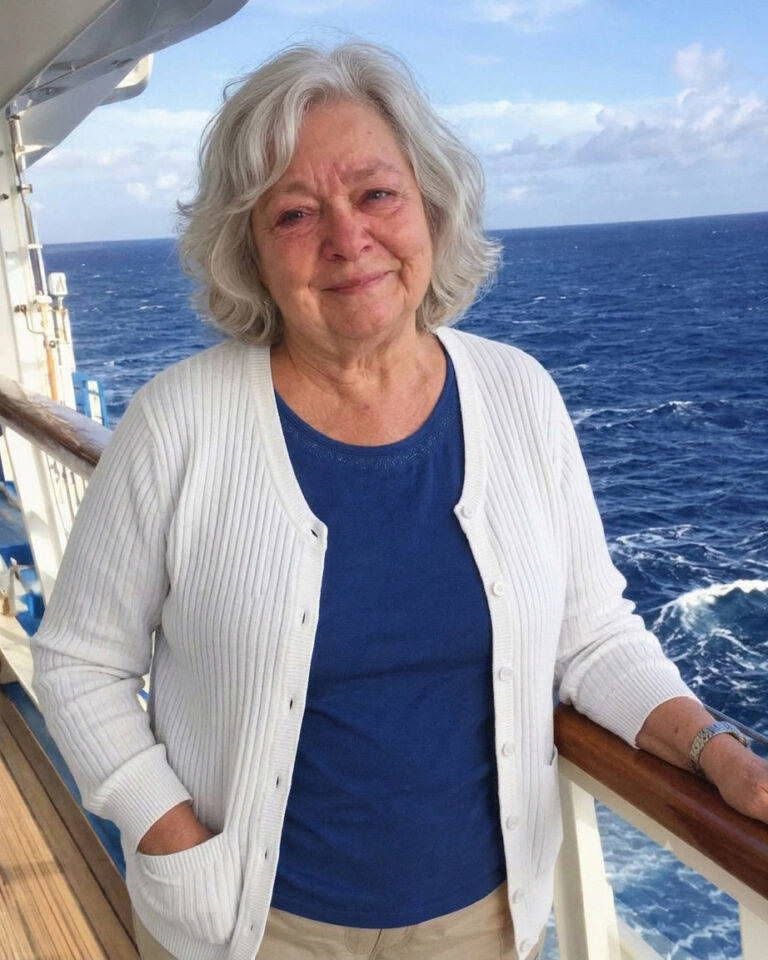
Instead, I picked up the letter the officer had brought.
Martin explained he’d begun preparing the map long before his illness.
Fifty places to celebrate fifty years, chosen from ports he’d visited and destinations he’d always wanted me to experience.
He’d intended to complete it during his final voyages before our anniversary.
Then the doctors gave me the news, and my plans got shorter, he wrote. I’m sorry, honey. I won’t get it done. But two of my places are stops on our cruise, and I’ve left clues.
Visit them if you feel able.
That was Martin. Even after his death, he was leaving the choice to me.
The officer remained in the doorway, holding his hat.
“I’m Thomas,” he said. “I worked under your husband for several years. He trusted me with all this and told me to deliver it today, if you came.”
“If?”
I wiped my cheeks.
“I wasn’t sure you’d come, ma’am. He told the crew about his mermaid who only wanted to stay on land.”
I laughed through my tears. “He told everyone that joke?”
“Every new officer.”
Thomas gestured toward the map.
“I could explain the shore excursions for you. But Martin wanted you to find the places yourself.”
Then he departed, leaving me alone with fifty destinations and no husband.
I spread the map across the bed.
The first marked location was a waterfront café at our next port. I recognized it before reading the label.
Martin had sent me a postcard featuring that café while we were dating. I still kept it in a shoebox at home.
My first instinct was to remain aboard.
I’d already accomplished something I once considered impossible by boarding the ship. But stepping ashore and exploring an unfamiliar town without Martin required another kind of courage.
Wasn’t taking the cruise enough?
Then I reread his penciled clue in the margin.
Go on, love. It’s only lunch.
I carefully folded the map.
I’d try, just that one café.
The following morning, I stood at the top of the gangway for five full minutes.
Passengers flowed around me like water around a stone.
“Ma’am, can I help you find something?”
A young crew member in a spotless white shirt was watching me with concern.
“The harbor café,” I said. “The one with the blue awning?”
He pointed along the quay.
“Ten minutes’ walk. You can’t miss it.”
Ten minutes.
I could manage that. Martin had walked the same route countless times.
The café occupied a corner overlooking the water, with seagulls circling overhead and salt hanging in the air.
It looked almost identical to the postcard Martin had mailed me decades earlier.
I stopped, pressing a hand over my mouth.
I took the photograph from my bag and compared it with the café before me.
There was Martin, much younger, smiling at a small round table.
Beside him sat an empty chair.
I turned the photograph over.
On the back, he’d written:
Saved you a seat.
I began laughing and crying simultaneously.
For years, I’d imagined Martin visiting these places without me.
But the photograph showed he’d kept an empty chair beside him, along with a message promising that seat was mine.
I found a table offering nearly the same view and sat down.
My plan was straightforward: take a photograph, then return to the ship.
But I remembered Martin describing the fish stew and the fishermen unloading their boats.
“Can I get you something?” the waiter asked.
“My husband used to eat here. Years ago. He always spoke highly of the fish stew.”
“Then try the stew,” he said. “So you can tell your husband that your cooking is better.”
His innocent remark hurt, but I nodded, concealing my tears.
I finished every bite.
Afterward, I photographed the harbor and the vacant chair opposite me. Leaving the chair out somehow felt wrong.
Between eating the bread and finishing my stew, I realized I’d actually enjoyed myself.
Guilt immediately followed.
How could I find pleasure in anything when Martin was gone?
Back aboard, I encountered Thomas near the elevators.
I told him about the café, the photograph, and how I’d managed to stay for lunch instead of immediately returning.
