
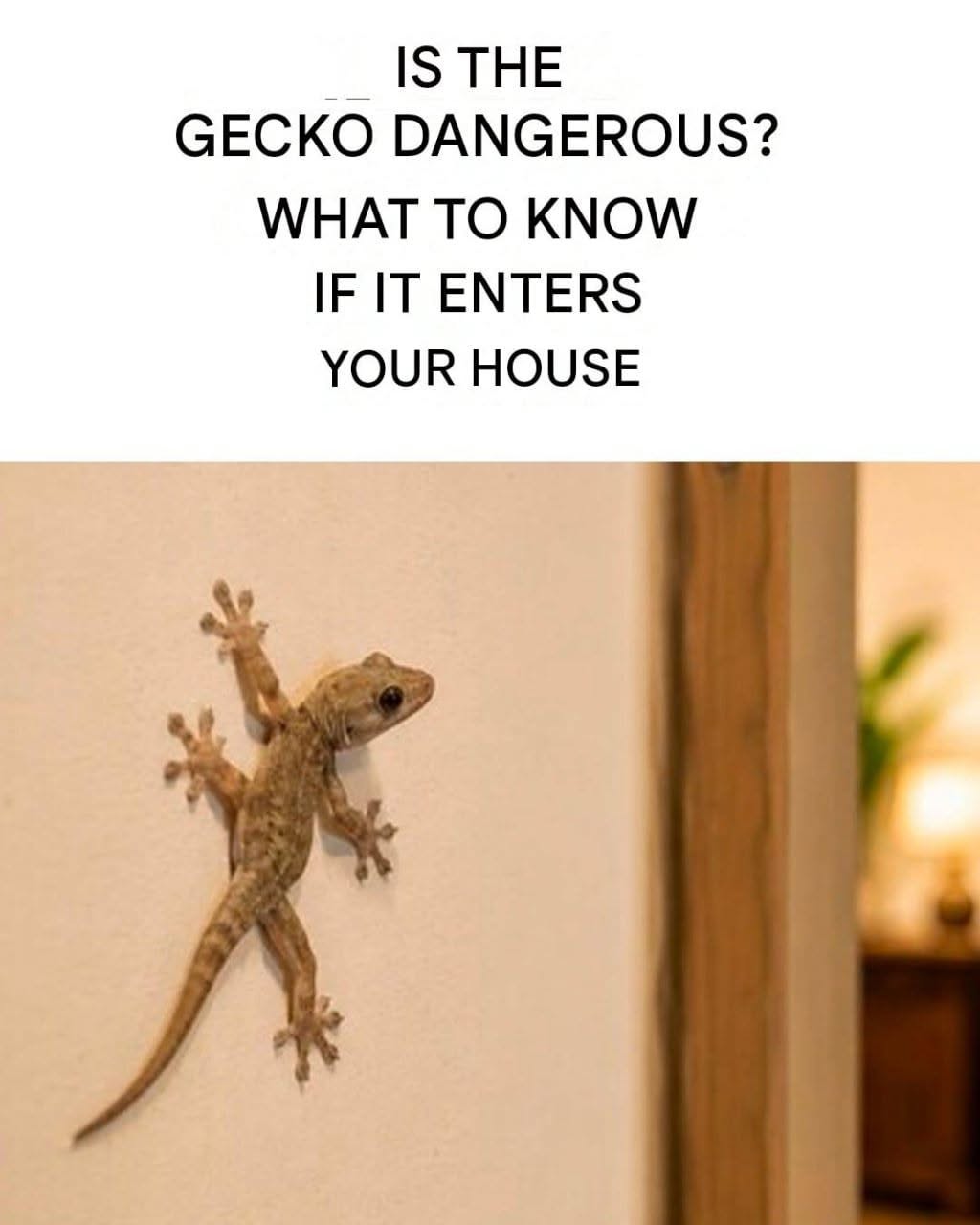
Are geckos dangerous animals? Here’s what to know if you find one in your home or on your balcony, why they enter houses, and how to keep them away without harming them.
Edited by
Editorial Staff
SHARE
Finding a gecko in your home can be frightening, especially when it suddenly appears on a wall or near a window. In reality, the geckos commonly found in Italian homes are generally harmless to people and tend to avoid contact with humans.
Their presence is usually linked to the search for food and
favorable environmental conditions. Before trying to remove them, it is therefore useful to understand why they enter homes and how to guide them outside safely and without harming them.
Can Geckos Bite?
Geckos do not normally seek contact with people. If they feel threatened, they may try to defend themselves, but aggression toward humans is very rare.
They are not animals that attack people while they sleep or deliberately approach them.
It is still best to avoid picking up a gecko with your bare hands, especially if you do not
know which species it is.
Why Does a Gecko Enter the House?
The main reason is often the presence of insects.
Geckos are predators that feed on flies, mosquitoes, moths, and other small insects. Lights left on at night attract these insects, which can in turn attract geckos.
A brightly lit window or balcony can therefore become an especially attractive place for these small reptiles.
Why Can Geckos Climb Walls?
Geckos have specialized feet that allow them to move easily across vertical surfaces.
Their toes contain microscopic structures that help
them adhere to surfaces, allowing them to climb walls, glass, and other materials.
This remarkable ability makes it easy for them to reach windows and balconies while searching for insects.
What to Do If You Find a Gecko in Your House
If a gecko accidentally enters your home, there is no need to use insecticides or try to hit it.
The simplest solution is to open a window or door leading outside, creating a clear escape route.
If the gecko remains still in a corner, you can gently place a
container over it and slide a piece of cardboard underneath. You can then carry it outside and release it safely.
Avoid sudden movements, and never press or crush the animal against a wall.
How to Prevent Geckos From Coming Back
To reduce the chances of geckos returning, start by reducing the things that attract them.
Turn off unnecessary lights near doors and windows, especially at night.
Install and maintain intact mosquito screens.
Check for cracks and gaps around window frames, doors, and shutters.
Seal openings that may be large enough
for a gecko to enter.
Reducing the number of insects around your home can also make the area less attractive to geckos.
Geckos Are Useful in Gardens and on Balconies
Finding a gecko on your balcony or in your garden does not necessarily have to be considered a problem.
On the contrary, these small reptiles help control populations of flies, mosquitoes, moths, and other insects. Leaving a gecko outdoors allows it to continue playing its natural role in the ecosystem.
If it stays outside and is not causing any problems,
there is generally no reason to remove it.
Be Careful With DIY Repellents
Garlic, pepper, citrus peels, and other substances are often recommended online as natural gecko repellents.
However, their effectiveness is not well established, and some substances may unnecessarily irritate or harm animals.
A more effective approach is to address the reasons geckos are attracted to your home: reduce insect populations, limit unnecessary outdoor lighting, and close potential entry points.
Geckos Should Not Be Confused With Other Reptiles
Italy is home to several species of small geckos, particularly in
warmer regions. Their appearance can vary, and not all individuals are the same size or color.
If you encounter an animal with unusual characteristics or cannot confidently identify it, it is best not to handle it. Instead, give it space and allow it to move away on its own.
So, Are Geckos Dangerous?
For people, the common geckos found in Italian homes generally do not pose a danger.
They are not aggressive, do not normally seek contact with humans, and usually enter homes in search of insects, food, or shelter.
So, if you find a gecko inside your home, there is no need to panic. Opening a door or window leading outside and giving it time to leave is often the simplest solution.
If you find one on your balcony or in your garden, however, it can generally be left alone. There, it can continue doing what it does naturally: helping to control insect populations and contributing to the local ecosystem.
Lupins are legumes rich in beneficial nutrients, particularly plant-based protein and fiber, which can support heart health. Thanks to their nutritional profile, lupins can be a healthy addition to a balanced diet and may contribute to better cardiovascular health.
Edited by Ohga Video Editors
Lupins are legumes with an impressive nutritional profile and potential benefits for cardiovascular health. Although they are often overlooked, they deserve a place in a balanced diet because of their high content of protein, fiber, and other beneficial nutrients.
